Memorial Day 2018

My buddy, Jeff, who prays for me EVERY night!
|
Memorial Day 2018
|
|
Happy Memorial Day!! I am late…. at planting, pruning, prepping, and potting. There are gardenias to replace (thank you, dogged winter) and much overall work to be done. But John and I will get to it…. I’m sure of it…. pretty sure… This month we celebrate Memorial Day, one of our most revered holidays. I am reminded of the wonderful Blassie family from Missouri, whose brother, Michael, was a jet pilot in the Vietnam war, and the first unknown soldier to be exhumed and positively identified through DNA testing several years ago. For generations, their family has selflessly served our country. This year, I have the opportunity to celebrate with their entire family – and it is an honor! Kay and I leave this weekend for a women’s conference in Laurinburg, North Carolina. En route, we will swing by the airport and pick up one of my lifelong friends – and we can’t wait! Maybe we can talk her into sharing a song with us…. We love you, and we hope to see you soon. Happy planting, bountiful blooming, and keep those clay pots watered (right, KP?) Love and Blessings,
Janet
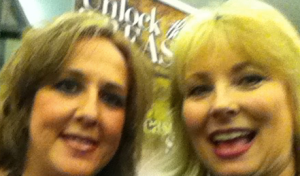
![]() The beautiful Edwards sisters ….. they “grew up” with my music.
![]() Little Lisa, who could singlehandedly usher in world peace. She knows no strangers… |
My Hope Is Built On Nothing Less
Edward Mote was raised by atheist parents. As an adult he remarked, “So ignorant was I that I did not know that there was a God.” At 18 years old, however, he heard the gospel and was baptized. At 55, he began his first Baptist pastorate in Sussex, England.
During his lifetime he wrote more than 100 hymns, some of which have become standards in our churches and, more importantly, in our hearts. Here is my favorite:
My hope is built on nothing less
Than Jesus’ blood and righteousness
I dare not trust the sweetest frame
But wholly lean on Jesus’ name
On Christ the Solid Rock, I stand
All other ground is sinking sand
When darkness veils His lovely face
I rest in His unchanging grace
In every high and stormy gale
My anchor holds within the veil
(Refrain)
His oath, His covenant, His blood
Support me in the whelming flood
When all around my soul gives way,
He, then, is all my hope and stay
(Refrain)
When He shall come with trumpet sound
O, may I then in Him be found!
Dressed in His righteousness alone,
Faultless to stand before the throne!
(Refrain)
Amen and amen!
Blessings to you all,
Janet
GOD WITH US
For several years my dad operated a pulp wood yard. This ‘yard’ included an office building, heavy loading equipment, mountains of logs and, our favorite, a stretch of train track that ran right along the front. Dad was extremely careful over us, warning of the potential dangers that each apparatus represented and diligently policing our movements. I’d have climbed every stack of logs in the yard had he allowed it.
Our favorite part of the day was after lunch when the logging traffic slowed and dad would take us for a walk on the railroad track. We walked in the middle, navigating the broad slats and occasionally balancing atop the rails. There was one section that narrowed significantly, offering little or no shoulder to escape the track. More than once, along that stretch, dad would say, “Okay babies, let’s get along. There’s a train coming,” and we would rush down the track to the wide, flat parcels. We did not see a train; we did not hear a train. We asked daddy how he knew a train was coming and he explained that he felt the vibrations of the rails.
Kay and I did not know we were in danger. We did not see or hear it. We lumbered along those tracks with no thought of our safety; not because we were familiar with the characteristics of railroads, but because we were intimately familiar with the characteristics of our father. He loved us; he watched us; he would protect us. We felt safe as long as he was with us.
God laid out before Moses a great commission. Flabbergasted, Moses asked, “Who am I, that I should go to Pharaoh and bring the Israelites out of Egypt?” And God said, quite simply, “I will be with you.” (Exodus 3:12)
When Joshua stepped into Moses’ role, the Lord assured him, “As I was with Moses, so I will be with you; I will never leave you nor forsake you.” (Joshua 1:5)
His promise to unite Israel came after dry bones rattled and ligaments joined bone to bone, “I will put my sanctuary among them forever.” (Ezekiel 37:26)
To Gideon He promises, ‘I will be with you.’” (Judges 6:12-16) He encourages Jeremiah, “Do not be afraid of them, for I am with you …” (Jeremiah 1:6-8) His word through Isaiah, “When you pass through the waters, I will be with you.” (Isaiah 43:2)
David learned, “Even though I walk through the valley of the shadow of death, I will fear no evil, for you are with me…” (Psalm 23:4) Jesus told His disciples, “You will leave me all alone. Yet I am not alone, for my Father is with me.” (John 16:32)
The Lord spoke to Paul in a vision, “…. keep on speaking, do not be silent. For I am with you .…” (Acts 18:9) Peter declared the works of God, “…. because God was with him.” (Acts 10:38)
God’s proximity was foretold by the prophet Isaiah “The virgin will be with child and will give birth to a son, and they will call him Immanuel.” (Isaiah 7:14) The Hebrew translation is staggering: ‘God with us.’
Jesus added finality to the promise when He spoke to the eleven disciples at Galilee, words that have resonated in the hearts of everyone who ever believed He was who He said He was: “And surely I am with you always, to the very end of the age.” (Matthew 28:20)
It has often been a late summer breeze that awakened my senses and stirred my heart to let me know, in that moment, God was with us. I have gazed at a winter sky when Jupiter gleamed especially bright, knowing, somehow, that the Creator God was near. Just as surely as I have felt the hand of my father while maneuvering a railroad track, I have felt the divine, careful orchestration of the events and moments of my life and I remain amazed that the God of the ages still concerns Himself with the day to day.
So, this Christmas, we celebrate the miraculous: His arrival. But always, we celebrate the unfathomable: God with us.
Collectors and Keepers
It is Thursday and rainy in North Carolina. Thankfully, I was able to get my walk in this morning when it was clear.
This morning I left my headset at home and began to think of all the things I have for which to be thankful. I began by simply thanking the Lord for His blessings, including the details. As I progressed, I determined not to ask for anything but just to think on His goodness to me. Three miles later, I was back home without running out of reasons to be grateful.
Two weeks ago, I received my master’s degree in accounting – one more proof that God not only gives us what we desire (any degree at all), but makes it better than we ask. That was in my morning chat with Him.
I thanked Him because John and I will celebrate 18 years of marriage in July – and he is one of the most upright and honorable men I’ve ever known.
I thanked Him for my friendships that have endured for decades, for family members who knew the value of prayer, for a church and church family that continually amazes me.
I thanked Him for the awesome opportunity and responsibility in sharing His message for so many years and for the host of incredible people (salt of the earth) whom I have encountered.
After three miles, I better understood what matters.
Your list may be different from mine, but if you haven’t gone there in a while, it will make for a wonderful start to your day. I promise!
We love you all and hope to see you soon.
Janet
COLLECTORS AND KEEPERS
Psychologists say there are a variety of reasons why we collect things and why they matter to us. Sometimes we collect for the sheer pleasure of owning something that we see as lovely or pleasurable. Other times, our purposes are nothing more than simple investments, such as a book or a painting that might rise to a Sotheby’s offering. Sometimes we save things because they fill a void or provide emotional security. They offer order in a world over which we have little or no control.
And so we collect. So much so that there are names for collectors of postcards (deitiologist), coins (numismatist), teddy bears (archtophilist), clocks (horologist) and others. We display them, dust them, explain them, and for some reason, our brains are happy knowing that they exist nearby.
My family members are experienced collectors, but arbitrary keepers.
While our grandmother never discarded anything given to her from her children or grandchildren, if you ever commented that you liked something she had made or purchased, she offered to give it to you. Every shelf and tabletop in their home displayed trite vacation souvenirs, school photos, Christmas gifts, and painfully unique items crafted during Vacation Bible School. These things were not negotiable; they could not be had. The quilts that she sewed by hand, the fried pies filled with fruit from their trees, the cake she’d just taken from the oven, were all things she did not keep. As soon as they were finished, they were given away.
For my mom, collecting meant a thick sock weighted by mercury dimes, buffalo nickels, and wheat pennies, twisted at the top and secreted in a dresser drawer. On summer days in the 60s, I borrowed from her stash for use in my blue Tom Thumb cash register when the cinderblock store was in full swing. At the end of the day, I meticulously wiped clean, then returned each coin to the white crew sock. The following day, I repeated it all again.
When my nephew was young, he collected “sets”. Whether it was a McDonald’s offering or a cartoon adventure series, he held the toys at bay until they were all present and accounted for. Seven out of eight was not complete in his demure little brain; the world was not right until all of the henchmen were on guard.
Jesus collected a different breed of henchmen. He assembled fishermen, politicians, and IRS agents. He amassed poor, common, and uncommon. He chose doubters, deniers, mild-mannered, and feisty. He took them to mountains and hillsides, rooms and boats. He displayed His power through them, and followers became leaders, poor became enriched, and wealthy became benevolent.
But Jesus was a collector, not a keeper. When He was ready to divulge their divine mandate, He called them all together in one place. He had plenty to tell them, but, perhaps, He also wanted to see them all together as a team, as a set, once more. He knew that everything would soon change. He instructed them, blessed them, and then He let go of them.
He knew the price they would pay because He had chosen them. His Apostle, Paul, was led past the Nero’s palace to the arena where he would be killed. In front of the arena stood a great statue of Nero, towering 110 feet into the air. His name was carved into the base: Nero – Conqueror. I wonder whether Paul’s thoughts journeyed back to a prison in Corinth where the Holy Spirit led him to write, “Who shall separate us from the love of Christ? Shall tribulation, or distress, or persecution, or famine, or nakedness, or peril or sword? … Nay, in all these things we are more than conquerors through Him who loved us.”
Jesus’ reason was clear. He did not assemble disciples and apostles for pleasure or gain. Rather, it was to help Him bring order to a world of chaos. He sought to offer a solution for emotional insecurity, to fill a void that mankind could barely identify, much less heal.
Twenty-one centuries later, Jesus continues to collect followers. And He continues to let them go.

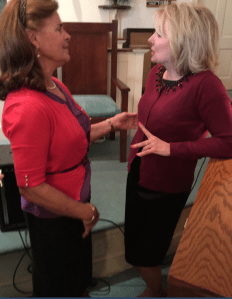
Sheila Sloan and I taking a concert break. She is amazing!
Graduation Day!
It’s official. Janet has completed her Masters degree in Accounting (having been inducted into two honors programs).
Commencement ceremonies are to take place Friday May 12, 2017.
Congratulations Janet!
Merry Christmas!!!
Good morning, all…
It is just before 6am on Tuesday, December 6. John just left for work and I am prepping for finals.
Working on my degree has caused me to suspend other, less squeaky tasks. This is rationalized by the perennial promise that ‘I will get to them.’ The few Christmas gifts I have purchased are on the dining room table, unwrapped – but I will get to them. I have begged off of some Christmas concerts, knowing that I need the extra study days to turn this master’s degree into a wall hanging – but ‘I will do them later’. To Christmas events I have taken food purchased, not made at home – but ‘I will make up for it’, I repeat, ad nauseum. Sunday visits with my parents have sometimes been with lecture materials in hand – but I will make up for that, too.
Do you see a pattern here?
In the midst of all the stress, I had an epiphany moment…. Three days ago I was studying in my office downstairs. John was on the roof cutting some overhanging tree branches. With my ear half-tuned for any sound from above, I heard a thud. Alarmed, I ran upstairs and onto the porch, calling for him. He made fun of my panic (which was good medicine) and we laughed even while I issued my tired old warning of the danger of ladders.
When I walked back inside, the lesson of the event was glaring, namely, “I am so blessed.” I stood in the kitchen realizing that a man who is smart, handsome, godly, engaging, and trustworthy loves me. Why sweat the small stuff? Then I thought of my parents – some of the richest people I know. Not materially, but rich in spirit and experience and kindness and common sense. They are healthy and well. Why sweat the small stuff? My only sister and I are as close as sisters can be; I attend a great church that her husband pastors and it is filled with wonderfully warm, salt-of-the-earth people. Why sweat the small stuff?
There is more – much more – but this is a lesson that you all probably know already: Spend your holidays doing things that matter with those who matter.
We love you all and hope to see you soon.
Merry Christmas!
Janet

We got to sing “HAPPY BIRTHDAY” to Elizabeth in Virginia. What a beautiful lady!
Captain Of My Soul
Literature, as life, seems to demand that its protagonists travel full circle. Opened doors must be closed, and closed, reopened. Suffering seeks remuneration; matters seek resolution. Noble avenues are pondered; forbidden paths explored, and reparation made.
Nineteenth century poet, William Ernest Henly, was diagnosed with tuberculosis as a child. At seventeen, he lost his left leg to complications from the disease. This traumatic event resulted in a poem of self-sufficiency that has been memorialized in classrooms for decades, written during his recovery, Invictus. The final verse:
It matters not how strait the gate,
How charged with punishments the scroll,
I am the master of my fate:
I am the captain of my soul.
When Timothy McVeigh was executed for the Oklahoma City bombing, he left behind a handwritten copy of the poem.
Shakespeare’s King Lear demonstrates the inevitable fall of one who dug a deep pit. “The wheel is come full circle,” declared Edmund, when his cunning calculations ultimately failed.
Graham Greene’s The Power and the Glory features an unnamed, alcoholic ‘whiskey priest’. After trudging through repentance and forgiveness, he risks his life to administer final rites to a dying man. He was captured and executed. Reparation was complete.
The Man Who Was Thursday, by G. K. Chesterston, explores the world of espionage. Seven men, each assigned the name of a weekday are led by Sunday, whom they come to view as aloof and unsympathetic. They eventually discover that his dispassionate demeanor was part of a larger, intricate plan that would benefit all involved. Unwilling to reveal the reasons for his behavior, the six men ask whether he has ever suffered. He borrows from Jesus the question He asked of James and John, “You don’t know what you are asking. Can you drink the cup I am going to drink?”
Some doors close more slowly than others.
Theodore Dreiser wrote An American Tragedy in 1925, patterned after an actual event in New York. The son of a street preacher, desperately poor, moves to another town to work. He falls for a poor factory worker until he begins to climb the corporate and social ladder. Courted by a rich, beautiful socialite, he agonizes over how to resolve his duplicitous situation. At the end of the book we are told there is another street, another preacher, and another blond haired boy staring up at his father.
Anne Morrow Lindbergh’s first child was born on her birthday. At 20 months old, he was kidnapped and, ultimately, murdered. Five children and more than twenty years later, she went to Florida’s Captiva Island and penned Gift From the Sea, examining the spectrum of life’s events through that undulating, salty lens.
“The sea does not reward those who are too anxious, too greedy, or too impatient,” she wrote. “To dig for treasures shows not only impatience and greed, but lack of faith. Patience, patience, patience, is what the sea teaches. Patience and faith. One should lie empty, open, choiceless as a beach – waiting for a gift from the sea.” No doubt, losing a child empties you like nothing else.
God walked in the garden with Adam and Eve. He talked with them. He shared directives for living life to the full. In this beginning, God sought to help His children avoid evil. In an ironic twist, following His resurrection, Jesus, too, walked in a garden. He closed a door to disobedience that mankind had opened. He corralled the wickedness we had unleashed. He rewrote our history, taking the keys to death, hell, and the grave and securing our lives to His safekeeping.
Life brings full circle every decision we have made, every seed sown. God, in His infinite mercy, tills the land, making beauty of our ashes.
So, no, William Ernest Henly, we cannot agree. It does matter that we choose the strait gate, the narrow way. It matters that there had to be a reckoning, a punishment for our violations.
Dorothea Day said it best when she responded to Invictus with a poem titled, Conquered, which concludes:
I have no fear though straight the gate:
He cleared from punishment the scroll.
Christ is the Master of my fate!
Christ is the Captain of my soul!
Three Requirements of Summer
Hey Everybody,
It’s June, and I find myself asking with some frequency, ‘What year is it?’ My parents always said that time accelerates as we get older. So, so true.
I enjoy the physical and emotional benefits of long walks. For years, I shunned headphones, choosing instead to listen to the sounds of life in real time. This year, however, I’ve been listening to the book of Revelation, as read by Max MacLean. What a difference it makes! It encourages me that God is still working within His long term plan. He still turns the hearts of kings, and He is still the final authority for all time. It reminds me that His plans are so much bigger than our little myopic view that we cannot even fathom how the course of His future will unfold. Read it. Read it again. Then again. It is uplifting and surprisingly comforting. Our lives are in creative, caring, authoritative hands.
We continue to meet wonderful people in the concerts. This year, we’ve spent time with ladies and gentlemen from California to the Carolina coast, and I am still amazed at the disseminate richness of the body of Christ.
I’ve completed my undergrad degree and tiptoed into the Masters program. Scheduled to finish next May. Some days I still shake my head and ask, “I’m doing what?”
Enjoy this time of the year. Summer should require of us three actions of intent:
*Stop and smell the fresh cut grass;
*Spend extra time examining the colors of the
season;
*Stand in a summer rain at least once.
I wonder if we could get a bill sponsored?
We love you all and hope to see you soon.
Love,
Janet
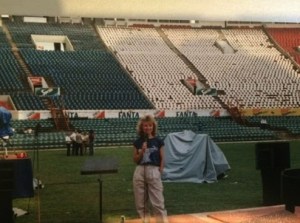
PS… Oops! This picture is a rehearsal from Johannesburg, South Africa – not Paraguay, as I stated last month. I received an email from one of our drivers in Johannesburg correcting me. Sorry!